Published by order of the Registry, and fixed to the church door, that none may plead ignorance of the arrangement under which we all live.
In the year 1736, Parliament repealed the old Act against witchcraft. The law did not find that there were no witches. It found that there was no crime. The distinction is a lawyer’s, and you now live inside it.
The fires went out that year. And the old neighbours — the ones your grandmother would not name after dark, and she was right — came home, to a country that no longer had a court to try them. They were not changed by their absence. We were. The Act itself may be consulted at the office; it bears the signature of his lordship, ————, though the ink of the striking-out is not the clerk’s, and the clerk has declined to say whose it is.
They are registered. Every one of the uncommon sort residing in this parish is entered in the Register below, with a number, a lineage, and a licensed trade. The reader will search that book for his own name in vain. Persons are not registered. The law counts what it can be sure of counting.
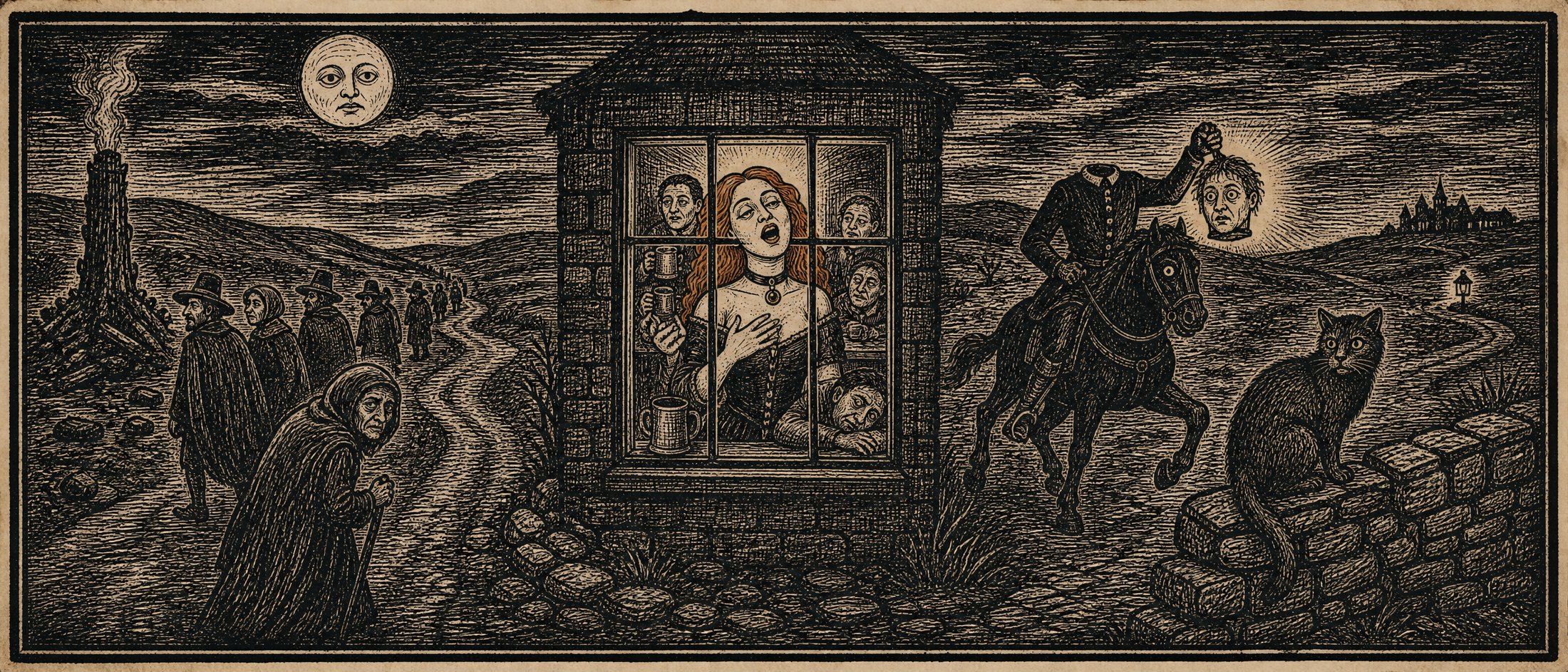
They are licensed. The singer’s trade is grief, and it is a lawful trade. The rider’s trade is collection. The cat’s trade is her own affair, and the clerk has stopped asking. A licence is not a leash; it is a receipt. The parish knows what lives here. This is not the same as governing it.
They are recorded. What can be printed, the Mercury prints. What cannot, the Register keeps. Between the two very little is lost, and nothing is explained.
Advice, Offered Without Charge
Keep iron about your door. This is not superstition. It is maintenance.
Give your surname to any neighbour that asks it. Your Christian name is your own property, and the parish advises you to keep it so.
If you hear singing, and can find no singer, you are not obliged to listen. Those who have listened are agreed on this point, briefly.
The lights on the moor after dark are not the parish’s lamps. The parish lights nothing past the bridge. Do not follow them, and do not thank them.
The parish bids you welcome. The uncommon sort have signed nothing, promised nothing, and kept this arrangement, these fifty years and more, better than we have kept most treaties. Complaints may be lodged with the Clerk between the hours of nine and four. The parish takes no responsibility.